
Migratory birds connect people, ecosystems, and nations…their epic journeys inspire people of all ages, across the globe…[and are a] symbol of an interconnected planet. -António Guterres
After the Rock Pigeon or European Starling, one of the most common and well known birds in the US is the Canada Goose. We might pass by fields filled with geese without giving them a second glance, while others might carefully sort through the flock looking for a rarity hiding in plain sight.
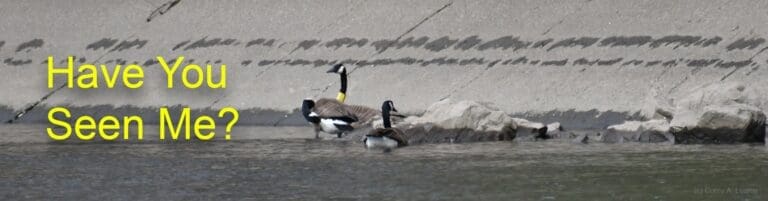
Researchers in Denmark are particularly interested in a small subset of these birds and are asking for our help. If you have found a Canada Goose with a yellow neck collar whose ID number starts with a “G” and/or a tracking device (also has a ID number beginning with a “G”), please send an email to Doug Beach (beachgolfdesign@att.net) – if you have a photo of the bird that’s even more helpful.
The Canada Geese who have a “G” collar were banded in Greenland (by the scientist from Denmark) where there has been a population increase in recent decades. There’s a theory that they might be inviting some of their Greenland friends for a fall migration trip to the US. Please make note if you see any of these birds with some of our rarities (Pink-footed or Greater White-fronted geese).
Bird Banding – Why Do We Do It?
Bird banding has been a way for scientists and ornithologists to track bird movements since the early 1800s. For example, an American Herring Gull banded on a rooftop of the Portland Museum of Art in Portland, Maine (where it had hatched) spends it’s winter in an Old Saybrook, Connecticut parking lot where it has been sighted several times over the course of a few years. Some Black Skimmers are spending their days roosting on a floating dock during the offseason in Charleston, South Carolina just south of where they were banded in North Carolina. Both are examples of how birders have helped scientists fill in the blanks on bird migration.
So How Can You Help?
- If you see a Canada Goose with a yellow collar that starts with “G”, send an email to Doug Beach – beachgolfdesigns@att.net
- If you see a bird with any other type of band, report it to the US Bird Band Laboratory.
- For more information about the US Bird Banding Laboratory, check out their post: Overview of its History and Current Practices
If you have any questions, please reach out by emailing contact@ctbirding.org